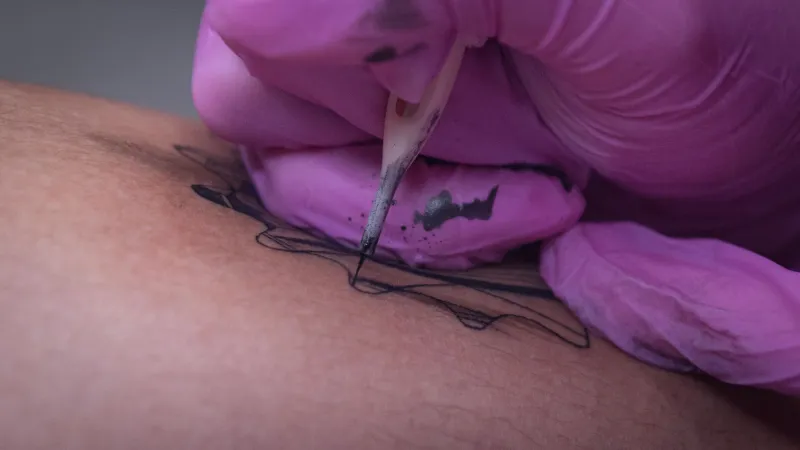
Til Death (or Divorce) Do Us Part: The Messy Reality of Couple's Tattoos After the Breakup
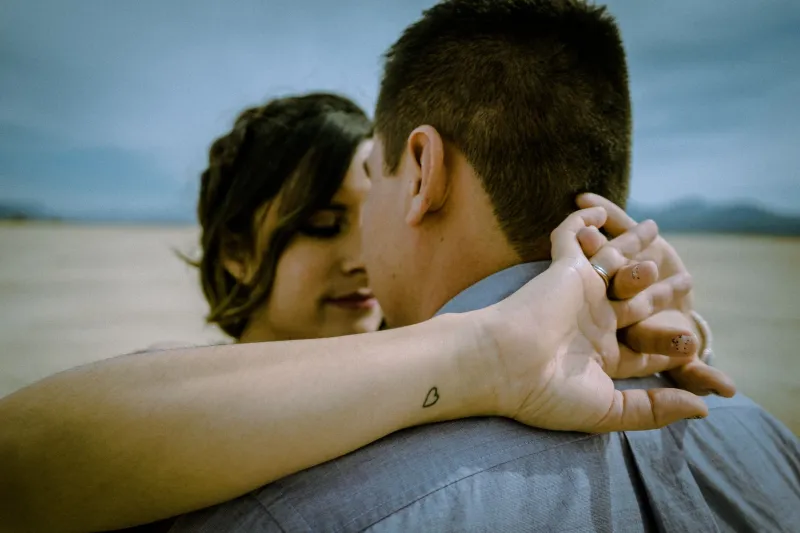
Let's be real: getting tattooed with your partner is one of the boldest romantic moves in the book. It says I'm all in. It says this is forever. And sometimes, it says I clearly did not think this through.
Because here's the thing nobody warns you about when you're sitting in matching chairs, holding hands while the needle buzzes—relationships end. Feelings shift. People change. But that little infinity symbol on your wrist? That one's not going anywhere on its own.
Couple's tattoos have exploded in popularity over the last decade, fueled by social media aesthetics and the very human desire to mark something meaningful on your body. But tattoo artists across the country will tell you that for every set of matching tattoos they put on a happy couple, they're eventually seeing at least one half of that couple back in the chair, looking for a way out.
The Emotional Wreckage Nobody Talks About
Breaking up is hard enough. Breaking up when your ex's name is permanently etched into your forearm? That's a whole different level of complicated.
Sarah, a 29-year-old from Austin, got matching floral pieces with her college boyfriend after two years together. When they split eight months later, she found herself in an unexpected grief spiral—not just over the relationship, but over the tattoo itself.
"Every morning I'd look at it and feel this gut punch," she says. "It wasn't even his name or anything super obvious, but I knew what it meant. And it felt like carrying around a scar I didn't ask for."
Psychologists who work with grief and identity say this reaction is completely valid. Tattoos are deeply tied to personal narrative—they're physical markers of who we were at a specific moment in time. When that moment becomes painful, the tattoo can feel like a trap, a constant reminder of a story you're trying to close.
But not everyone sees it that way.
Marcus, 34, from Chicago, has his ex-wife's name tattooed on his ribcage. They divorced three years ago after a seven-year marriage. He has zero plans to remove or cover it.
"That relationship made me who I am," he says flatly. "I'm not going to pretend it didn't happen. She was part of my life. The tattoo stays."
Both reactions are valid. Both are real. And both are way more common than people admit.
How Tattoo Artists Are Handling the Fallout
Talk to any seasoned tattoo artist and they'll have a story—or ten—about the couple's tattoo aftermath. It's practically a genre at this point.
Jamie, a tattoo artist based in Nashville with over twelve years in the industry, says the cover-up consultations are some of the most emotionally loaded appointments she takes.
"People come in at all stages of grief," she explains. "Some are angry and want it gone yesterday. Some are kind of laughing about it. Some are still crying. You have to read the room fast and be part artist, part therapist."
Cover-ups require serious skill. A tattoo artist can't just slap something dark over an existing piece and call it a day—the new design has to be strategically planned to fully conceal what's underneath while still looking intentional and beautiful. Names are particularly tricky because of their sharp, defined lines.
"A name on someone's arm or chest is one of the hardest things to cover cleanly," Jamie says. "You're usually looking at something bold—a big floral, a geometric design, an animal piece. Something with enough mass to do the job right."
The good news? Cover-up artistry has gotten dramatically better. The days of slapping a black panther over your ex's name and hoping for the best are long gone. Today's artists are doing genuinely stunning transformation work.
The Rise of the Breakup Cover-Up Party
Somewhere along the line, someone decided that heartbreak deserved a celebration—and honestly, we're here for it.
Breakup cover-up parties have quietly become a thing in tattoo communities, especially in cities like Los Angeles, New York, and Denver. The concept is simple: a newly single person brings their crew to a shop, gets the ex's ink covered or transformed, and turns the whole experience into a reclamation ritual.
Some shops have even started offering group booking discounts for the occasion, recognizing that the newly single person rarely shows up alone.
"It started with one client who brought four friends," recalls Devon, a shop owner in Portland. "They all got tattooed that night. It became this whole cathartic thing. Now we get a few of these a year and honestly, they're some of the best energy in the shop."
There's something genuinely powerful about the concept. You're not erasing the past—you're literally transforming it into something new, right on your skin. That's a pretty metal way to process a breakup.
The Smart Play: Tattoos Built for Heartbreak
The tattoo industry, ever adaptive, has started responding to the couple's tattoo dilemma with a practical solution: designs that are intentionally built to stand alone or connect with a partner's piece.
Think of it as the prenuptial agreement of body art.
Instead of getting each other's names or a design that only makes sense as a matching set, some artists are now steering couples toward complementary pieces—tattoos that look complete on their own but gain an extra layer of meaning when placed next to a partner's. A moon that works solo. A sun that works solo. Together, they're a set. Apart, they're just beautiful standalone tattoos.
"I started suggesting this approach a few years ago after doing too many cover-ups," says Marcus, a tattoo artist in Atlanta. "I'm not trying to be cynical about love. But I am trying to protect my clients. A tattoo should work for you no matter what happens in your life."
This kind of forward-thinking design philosophy is becoming more common, and honestly, it's smart. It honors the sentiment of the moment without leaving someone stranded if the relationship runs its course.
Keeping It, Hating It, or Owning It
Here's the bottom line: there's no universally right answer when a couple's tattoo outlives the couple.
Some people laser it off and never look back. Some cover it with something that reclaims the real estate entirely. Some keep it as a reminder of who they were and what they learned. Some even reframe the meaning entirely—a heart that used to represent a relationship now represents self-love, or family, or survival.
What matters is that the choice belongs to the person wearing the ink.
Tattoo culture has always been about owning your story, even the messy parts. Especially the messy parts. A couple's tattoo that survived a breakup isn't a failure—it's a chapter. What you do with it next is entirely up to you.
And if you need a crew to come with you to the cover-up appointment? That's what friends are for.
Got a couple's tattoo story—good, bad, or somewhere in between? Drop it in the comments. We want to hear it all.