Walls Made the Art: How Prison Tattoo Culture Crawled Out of the Dark and Onto the Main Stage
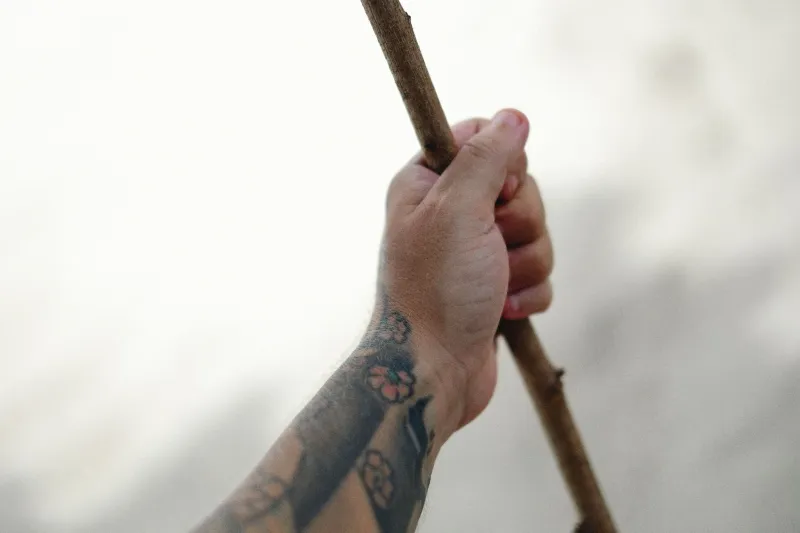
Long before Instagram feeds and convention floors celebrated the stick-and-poke revival, the technique was survival. A sharpened guitar string. A motor stripped from a cassette player. Ink made from melted chess pieces or burned plastic mixed with shampoo. In correctional facilities across the United States, tattooing wasn't a lifestyle choice — it was a coded language, a marker of identity, a way of saying I exist in a system designed to make you disappear.
Now that language is on the walls of upscale studios in Brooklyn and Silver Lake. And the conversation around how it got there is a lot messier than most people want to admit.
Where It Started
American prison tattoo culture didn't emerge from a single tradition. It's a collision of histories — the pachuco cross markings of Chicano gang culture in the Southwest, the teardrop and spider web symbolism that evolved through decades of East Coast penitentiary life, the dot-work patterns that carried meaning specific to particular facilities or affiliations. Every mark told a story. Every placement communicated something to someone who knew how to read it.
The tools were improvised because they had to be. Contraband tattooing was — and still is — prohibited in most U.S. prisons, which means the entire practice exists in defiance of institutional authority. That defiance, ironically, is a huge part of what makes the aesthetic so compelling to people on the outside.
"There's an authenticity to it that you can't manufacture," says Dario Vega, who spent eight years in a California state prison and has been tattooing professionally in the Bay Area for the past six. "Those marks meant something real. They weren't decorative. They were documentary."
Vega is careful about how much he romanticizes the environment that produced the art. "People died over those symbols. People lost years over those symbols. So when someone who's never been near a cell wants to get a teardrop because it looks cool, I have complicated feelings about that."
The Aesthetic Crosses Over
The crossover didn't happen overnight, and it didn't happen cleanly. By the mid-2000s, artists outside prison walls were already experimenting with the raw, lo-fi quality of hand-poked tattooing — the slight wobble in the line, the organic texture that a machine can't quite replicate. Zines and underground tattoo culture championed the roughness as a counter-aesthetic to the hyper-polished work dominating mainstream shops.
Then social media accelerated everything. Stick-and-poke accounts blew up on Tumblr and later Instagram. What had once been purely functional became fashionable. The imperfect line became a design choice. The coded symbol became a conversation piece for people with no connection to its original context.
High fashion noticed. Editorial spreads in publications like i-D and Dazed started featuring models with hand-poked work. Luxury brands — the kind that wouldn't have touched tattoo culture ten years ago — began referencing prison aesthetic in runway collections. The rawness got polished into product.
The Appropriation Question Nobody Wants to Answer
It's the tension running through every conversation about this crossover, and it doesn't have a clean resolution: when a style born from suffering and constraint gets adopted by people who face neither, what's lost?
Formerly incarcerated artists have a range of perspectives on this, and they don't all agree.
Some, like Vega, see opportunity in visibility. "If the style is getting attention, that attention should be able to reach people like me. I want to be in those conversations. I want to be the one people come to when they want that work."
Others are more guarded. Marcus Tillman, who did time in a federal facility in the early 2000s and now runs a small studio in Atlanta, draws a firm distinction between stylistic influence and symbolic adoption. "You want the aesthetic? Fine. You want the symbols? That's where I have a problem. Those weren't made for you. They weren't made to be cute."
The coded nature of prison tattoo language is precisely what makes this complicated. Unlike, say, a geometric pattern that reads as purely visual, many prison tattoos carry embedded meaning — affiliation, status, experience, loss. Lifting those marks without that context isn't just aesthetically hollow; to some, it's disrespectful in a way that goes beyond typical appropriation debates.
Redefining Legitimacy
One of the more interesting effects of this crossover is what it's done to the concept of "legitimate" tattooing. The professional tattoo world has long operated with a hierarchy — licensed shops, health-code compliance, formal training. Prison tattooing exists entirely outside that structure, and yet it produced some of the most technically skilled and conceptually rich work in American tattoo history.
Artists like Vega and Tillman, who learned their craft under the most constrained conditions imaginable, are now forcing the industry to reckon with a question it hasn't always wanted to ask: what does mastery actually look like when you strip away the equipment, the training, and the institutional validation?
"I learned to tattoo with a needle and a pen spring," Tillman says. "I had to understand skin on a level most people never will, because I had no machine to compensate for what I didn't know. That's not less than formal training. In some ways, it's more."
That perspective is gaining traction. Tattoo collectors who care about craft are increasingly seeking out artists with unconventional backgrounds. The provenance of the skill — where it came from, what it survived — carries its own kind of weight.
Where the Culture Goes From Here
The prison tattoo aesthetic isn't going back underground. It's too embedded now — in collector culture, in professional studios, in the visual language of American tattooing broadly. What's still being negotiated is who gets credit, who gets paid, and who gets to tell the story.
Formerly incarcerated artists are pushing for more than acknowledgment. They want seats at the table — convention spots, editorial features, mentorship pipelines that reach into reentry programs. Some organizations are starting to build exactly that infrastructure, connecting formerly incarcerated artists with professional resources and platforms.
The art came from the walls. The least the industry can do is make sure the people who built it inside those walls have a real shot at building something outside of them.
Because in tattoo culture, more than almost anywhere else, where you came from is written right there on your skin.